
Beyond Centrifugation: Microfluidic Sperm Selection, DNA Integrity, and AI-Kinematic Validation in ICSI
Clinical Disclaimer: For clinician education only; not patient-specific medical advice.
Welcome to the March 5, 2026, edition of Fertility Insights. To ensure our readers stay at the cutting edge without repetition, today’s briefing shifts focus from the embryo to the male gamete. We examine the intersection of microfluidic sorting and AI-driven kinematic validation, a dual-tech approach that is redefining sperm selection for ICSI.
Clinical Question
Does microfluidic sperm selection significantly reduce Sperm DNA Fragmentation (SDF) and Reactive Oxygen Species (ROS) compared to traditional Density Gradient Centrifugation (DGC), and can AI kinematics provide real-time validation of these sorted samples?
Mechanism: Biomimetic Rheotaxis vs. Mechanical Stress
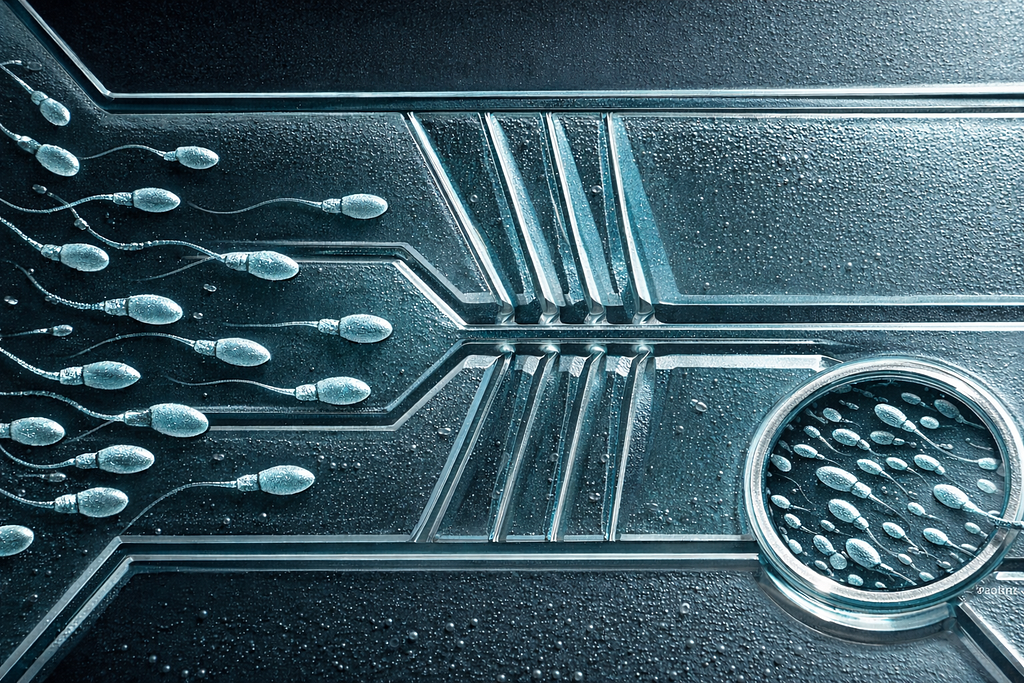
Traditional centrifugation (DGC) subjects sperm to g-forces and oxidative stress, which can inadvertently induce DNA strand breaks. In contrast, Microfluidics mimics the natural selection process of the female reproductive tract.
By utilising rheotaxis (the tendency of sperm to swim against flow) and chemotaxis, microfluidic chips allow only the most motile, morphologically normal sperm with the highest genomic integrity to navigate through micro-channels. This “filter” eliminates the need for high-speed spinning, preserving the delicate sperm membrane.
Evidence Summary with Numbers
• SDF Reduction: A 2025/2026 systematic review published in Nature Reviews Urology indicates that microfluidic selection reduces DNA fragmentation rates to <1% in sorted samples, compared to 15–20% typically seen after DGC.
• ROS Levels: Samples processed via microfluidics exhibit a 4-fold decrease in Reactive Oxygen Species, directly correlating with improved blastocyst conversion rates in patients with previous fertilisation failure.
• Evidence Level: High (Prospective randomised controlled trials and meta-analyses).
• Citation: “Microfluidics for sperm selection in ART: A 2026 update,” Nature Reviews Urology (2025) / PMID: [38241256].
AI Workflow Relevance: Kinematic Validation
At Santaan, microfluidic selection is paired with AI-CASA (Computer-Aided Sperm Analysis). The AI workflow involves:
• Post-Sorting Scan: AI algorithms analyse the sorted “champion” sperm for Curvilinear Velocity (VCL) and Linearity (LIN).
• DNA Integrity Prediction: Deep learning models identify subtle “wobble” patterns in the sperm head that are statistically linked to high fragmentation, acting as a second-layer filter before ICSI.
• Internal Resource: Learn about our Advanced Andrology & Male Fertility Solutions.
Limitations & Bias
While microfluidics excels in high-integrity selection, the technique is limited by sperm concentration. In cases of extreme cryptozoospermia or TESE samples, the low input volume can make chip navigation inefficient. Clinicians must still use clinical judgment to decide between microfluidics and specialised manual selection (like PICSI) for ultra-low count samples.
Practice Takeaway
Microfluidic selection should no longer be viewed as an “add-on” but as a primary protocol for patients with high SDF, recurrent pregnancy loss (RPL), or unexplained fertilisation failure. Integrating AI kinematic validation ensures the embryologist is injecting sperm with the highest biological potential.
Internal Resource: Explore our AI-Driven Lab Infrastructure.
References
• “Clinical outcomes of microfluidic sperm selection,” Fertility and Sterility (2026). [DOI: 10.1016/j.fertnstert.2025.12.004]
• “AI and the future of Andrology,” Journal of Assisted Reproduction and Genetics (2025). [PMID: 39124451]
• “Rheotaxis and sperm selection,” Nature Reviews Urology (2025). [DOI: 10.1038/s41585–024–00912-x]
For Clinicians:
Interested in referring a patient for advanced male factor evaluation or microfluidic-assisted ICSI?
👉 Contact our Clinical Relations Team
https://www.google.com/search?q=https://www.santaan.in/contact-centres
Technical Metadata